Key word, "HornBuckle" suggested by good friend, ltl<>mike.
Wednesday, October 19, 2005
Horn Buckle
Time for another round of Spin The Google Image.
Key word, "HornBuckle" suggested by good friend, ltl<>mike.


Key word, "HornBuckle" suggested by good friend, ltl<>mike.
Thursday, October 06, 2005
This Medium
Ok, I really enjoyed this recent speech by Al Gore.
But of course, I'm a long-time fan of the thinking and works of Marshall McLuhan and Lewis Mumford.
here's some snipets:
"""Television stations and networks, by contrast, are almost completely inaccessible to individual citizens and almost always uninterested in ideas contributed by individual citizens. . . .
Soon after television established its dominance over print, young people who realized they were being shut out of the dialogue of democracy came up with a new form of expression in an effort to join the national conversation: the "demonstration." This new form of expression, which began in the 1960s, was essentially a poor quality theatrical production designed to capture the attention of the television cameras long enough to hold up a sign with a few printed words to convey, however plaintively, a message to the American people. Even this outlet is now rarely an avenue for expression on national television. . . .
The German philosopher, Jurgen Habermas, describes what has happened as "the refeudalization of the public sphere." That may sound like gobbledygook, but it's a phrase that packs a lot of meaning. The feudal system which thrived before the printing press democratized knowledge and made the idea of America thinkable, was a system in which wealth and power were intimately intertwined, and where knowledge played no mediating role whatsoever. The great mass of the people were ignorant. And their powerlessness was born of their ignorance. """
Yep, the man may not have invented the Internet, but it appears he's trying to express/preserve what it is. I found it a provoking and even apt commentary...
Friday, September 30, 2005
Perhaps A Real Step Toward True Global Democratization
I want to teach the world to surf, says the man who invented the $100 laptop
By David Usborne in New York
One man in Boston has a plan that he hopes will bridge the world's gaping digital divide - and quickly. The visionary is Nicholas Negroponte, director of the Media Lab at the Massachusetts Institute of Technology and his idea consists of a new kind of laptop computer that will cost just $100 (£57) to buy.
It will also be a little different in design from the sleek machines some of us in the west have learned to love or covet. It will be foldable in different ways, encased in bump-proof rubber and will include a hand-crank to give it power in those corners of the globe where electricity supply is patchy.
The first prototype of the machine should be ready by November and Mr Negroponte - who was one of the first prophets of the internet before most of us understood the word - hopes to put them into production next year.
In fact, he expects to churn out about 15 million of them within one year, shipping most of them at first to children in Brazil, Egypt, Thailand and South Africa.
Describing the unusual design of his sub-laptop yesterday, Mr Negroponte insisted that it would "have to be absolutely indestructible". The mission is to create a tool that children almost anywhere can use and can easily carry between their classrooms and their homes. For that reason, for instance, the AC adaptor cable will double as a shoulder strap.
Support is also coming from closer to home. The Governor of Massachusetts, Mitt Romney, has also committed to buying half a million of the machines for distribution to lower-income school students in the state.
The inspiration of the project, which has backing from US companies including Google, came to Mr Negroponte when he was travelling recently with his wife in Cambodia. He spotted children in a rural area carrying laptops - which the couple's foundation had donated - from school to their homes.
To cut costs, the machines would have a 500-megahertz processor provided by Advanced Micro Devices, which is a little slow by today's lightning-speed standards.
However, it would be set up for wireless connectivity, known as wi-fi, to give users the greatest chance of hooking up to the internet. It would run on a Linux platform, which is freely available, rather than Microsoft's more expensive Windows.
It is not the first time that someone has attempted to develop a rock-bottom price device to feed the potentially monumental market in developing countries for laptops. Part of the problem has been stopping donated machines leaking onto the commercial market.
Mr Negroponte said that his laptops would be so distinctive in design and look that stealing and re-selling them would be akin to stealing furniture from a church. People would recognise where they come from. The look of the devices, he said yesterday, meant there would be "socially a stigma to be carrying one if you are not a student or a teacher". Consequently, he imagines that no more than 2 per cent of the devices would fall into that murky "grey market".
Other features of the device include being able to switch from a full colour screen to a monochrome alternative, which will much more easily viewed in bright sunlight. In the first models, turning the crank for one minute will provide 10 minutes of power.
Mr Negroponte says that rather than getting more expensive, as some brands do, he hopes that his machines will get cheaper through economies of scale. He pointed out that $100 was still expensive in many parts of the world. And he also expects the technology to improve.
(I know, I know. I'm such a copy and paste the news whore now a days.)
Wednesday, September 28, 2005
Well...Duh!
NASA Administrator Says Space Shuttle Was A Mistake
By Traci Watson
USA TODAY
The space shuttle and International Space Station — nearly the whole of the U.S. manned space program for the past three decades — were mistakes, NASA chief Michael Griffin said Tuesday.
In a meeting with USA TODAY's editorial board, Griffin said NASA lost its way in the 1970s, when the agency ended the Apollo moon missions in favor of developing the shuttle and space station, which can only orbit Earth.
“It is now commonly accepted that was not the right path,” Griffin said. “We are now trying to change the path while doing as little damage as we can.”
The shuttle has cost the lives of 14 astronauts since the first flight in 1982. Roger Pielke Jr., a space policy expert at the University of Colorado, estimates that NASA has spent about $150 billion on the program since its inception in 1971. The total cost of the space station by the time it's finished — in 2010 or later — may exceed $100 billion, though other nations will bear some of that.
Only now is the nation's space program getting back on track, Griffin said. He announced last week that NASA aims to send astronauts back to the moon in 2018 in a spacecraft that would look like the Apollo capsule.
The goal of returning Americans to the moon was laid out by President Bush in 2004, before Griffin took the top job at NASA. Bush also said the shuttle would be retired in 2010.
Griffin has made clear in previous statements that he regards the shuttle and space station as misguided. He told the Senate earlier this year that the shuttle was “deeply flawed” and that the space station was not worth “the expense, the risk and the difficulty” of flying humans to space.
But since he became NASA administrator, Griffin hasn't been so blunt about the two programs.
Asked Tuesday whether the shuttle had been a mistake, Griffin said, “My opinion is that it was. … It was a design which was extremely aggressive and just barely possible.”
Asked whether the space station had been a mistake, he said, “Had the decision been mine, we would not have built the space station we're building in the orbit we're building it in.”
Joe Rothenberg, head of NASA's manned space programs from 1995 to 2001, defended the programs for providing lessons about how to operate in space. But he conceded that “in hindsight, there may have been other ways.”
Shoot, I've been saying this for years. But you don't see me getting a headline on the DrudgeReport.
Kraken Captured! (Well, At Least On Film)
Whoa! For the first time in history, photos of a live Giant Squid have been taken!
Thank you National Geographic.

Like something straight out of a Jules Verne novel, an enormous tentacled creature looms out of the inky blackness of the deep Pacific waters.
But this isn't science fiction. A set of extraordinary images captured by Japanese scientists marks the first-ever record of a live giant squid (Architeuthis) in the wild.
The animal—which measures roughly 25 feet (8 meters) long—was photographed 2,950 feet (900 meters) beneath the North Pacific Ocean. Japanese scientists attracted the squid toward cameras attached to a baited fishing line.
The scientists say they snapped more than 500 images of the massive cephalopod before it broke free after snagging itself on a hook. They also recovered one of the giant squid's two longest tentacles, which severed during its struggle.

The photo sequence, taken off Japan's Ogasawara Islands in September 2004, shows the squid homing in on the baited line and enveloping it in "a ball of tentacles."

Tsunemi Kubodera of the National Science Museum in Tokyo and Kyoichi Mori of the Ogasawara Whale Watching Association report their observations this week in the journal Proceedings of the Royal Society B.
"Architeuthis appears to be a much more active predator than previously suspected, using its elongated feeding tentacles to strike and tangle prey," the researchers write.
They add that the squid was found feeding at depths where no light penetrates even during the day.
Giant Breakthrough
Despite people's fascination with this deep-sea behemoth, the giant squid's life and habits have remained largely a mystery. The little information known has been mostly based on dead and dying specimens that were caught by commercial fishing boats or washed ashore.
The mysterious creature has inspired countless sea monster tales and has been the subject of various scientific expeditions.
Since the mid 1990s there have been a number of research trips in search of giant squid. Cameras attached to deep-diving subs or sperm whales have been used to try to capture the elusive animals on film, but without success.
The Japanese researchers used sperm whales as guides to help them pinpoint likely giant squid haunts. Over the years whalers have reported finding a high number of large squid beaks in the mammals' stomachs, pegging sperm whales as primary predators of large squid.

The images are generating considerable excitement among squid experts.

"I think it's wonderful that we've finally got a picture of a living giant squid," said Richard Ellis, a research associate at the American Museum of Natural History in New York and author of The Search for the Giant Squid.
"I thought it would only be a matter of time before someone got images of Architeuthis," he added.
"After all, it's not an endangered species, not even all that rare, and it's one of the largest of all invertebrates. So the Japanese film finally breaks through and renders the statement 'nobody has ever seen a living giant squid' inoperative."
Squid expert Martin Collins of the British Antarctic Survey based in Cambridge, England, says the new images are a "fantastic" achievement.
The marine biologist says he was skeptical that a dedicated giant squid hunt would succeed. He thought the first wild sighting would probably come by accident.
"Fair play to these guys who've made the effort, gone out there and looked in what they thought was a good area, and found it," he said.
Hunting for Clues
Collins is especially interested in clues the images might provide to the way giant squid swim and hunt in the deep ocean.
"Seeing the animals on film gives you a tremendous insight into how they live down there," he said. "It shows they are pretty active animals, and that answers a big question that's been out there for some time."
Collins says there were two competing schools of thought among giant squid experts.
"One was the idea that [giant squid] were fairly inactive and just drifted around, dangling their tentacles below them like fishing lures to catch what came by," he said.
"The other theory was that they were actually quite active. This new evidence supports this, suggesting they are active predators which can move reasonably quickly."

"The efforts the squid went to untangle itself [from the baited fishing line] also shows they are capable of quite strong and rapid movement," he added.
The study team reports that the severed tentacle repeatedly gripped the boat deck and crew after it was hauled aboard. The squid's tentacles are armed with suckers, each ringed with tiny teeth to help snare prey.

Measuring 18 feet (5.5 meters) long, analysis of the tentacle confirmed it came from a giant squid and allowed the researchers to estimate the total length of the animal.
But the researchers caution that their data assume the tentacle was severed at its base. If not, the squid may have been considerably larger. The longest giant squid on record measured 59 feet (18 meters), including its two elongated tentacles.
Shedding Light on Giant Squid
Giant squid, along with their close cousins colossal squid (Mesonychoteuthis), have the largest eyes of any animal.
"Giant squid do have particularly large eyes, which would suggest vision is important to them. Having a large eye isn't unusual in deep-sea animals—you see it quite often in fish."

The fact that the animal caught on film was swimming in total darkness suggests the species detects prey using alternative light sources. "The only light down there is likely to be light produced by other animals," said Collins of the British Antarctic Survey.
The Japanese team thinks that research techniques similar to their own could be used to bring about more close encounters with giant squid. Ellis of the American Museum of Natural History agrees.
"I'm sure we can learn a lot from an analysis of these images," he said. "And now that we have an idea of where to look for [the squid], we will undoubtedly get more pictures."
I was going for a greater picture than text ratio on this post. I know I failed. I'll try shoving more pics in between the letters themselves next time.
And now for something completely similar...
The Kraken

Below the thunders of the upper deep,
Far far beneath in the abysmal sea,
His ancient, dreamless, uninvaded sleep
The Kraken sleepeth: faintest sunlights flee
About his shadowy sides: above him swell
Huge sponges of millennial growth and height;
And far away into the sickly light,
From many a wondrous grot and secret cell
Unnumbered and enormous polypi
Winnow with giant fins the slumbering green.
There hath he lain for ages and will lie
Battering upon huge seaworms in his sleep,
Until the latter fire shall heat the deep;
Then once by men and angels to be seen,
In roaring he shall rise and on the surface die.
-Tennyson
Thank you National Geographic.
Like something straight out of a Jules Verne novel, an enormous tentacled creature looms out of the inky blackness of the deep Pacific waters.
But this isn't science fiction. A set of extraordinary images captured by Japanese scientists marks the first-ever record of a live giant squid (Architeuthis) in the wild.
The animal—which measures roughly 25 feet (8 meters) long—was photographed 2,950 feet (900 meters) beneath the North Pacific Ocean. Japanese scientists attracted the squid toward cameras attached to a baited fishing line.
The scientists say they snapped more than 500 images of the massive cephalopod before it broke free after snagging itself on a hook. They also recovered one of the giant squid's two longest tentacles, which severed during its struggle.
The photo sequence, taken off Japan's Ogasawara Islands in September 2004, shows the squid homing in on the baited line and enveloping it in "a ball of tentacles."
Tsunemi Kubodera of the National Science Museum in Tokyo and Kyoichi Mori of the Ogasawara Whale Watching Association report their observations this week in the journal Proceedings of the Royal Society B.
"Architeuthis appears to be a much more active predator than previously suspected, using its elongated feeding tentacles to strike and tangle prey," the researchers write.
They add that the squid was found feeding at depths where no light penetrates even during the day.
Giant Breakthrough
Despite people's fascination with this deep-sea behemoth, the giant squid's life and habits have remained largely a mystery. The little information known has been mostly based on dead and dying specimens that were caught by commercial fishing boats or washed ashore.
The mysterious creature has inspired countless sea monster tales and has been the subject of various scientific expeditions.
Since the mid 1990s there have been a number of research trips in search of giant squid. Cameras attached to deep-diving subs or sperm whales have been used to try to capture the elusive animals on film, but without success.
The Japanese researchers used sperm whales as guides to help them pinpoint likely giant squid haunts. Over the years whalers have reported finding a high number of large squid beaks in the mammals' stomachs, pegging sperm whales as primary predators of large squid.
The images are generating considerable excitement among squid experts.
"I think it's wonderful that we've finally got a picture of a living giant squid," said Richard Ellis, a research associate at the American Museum of Natural History in New York and author of The Search for the Giant Squid.
"I thought it would only be a matter of time before someone got images of Architeuthis," he added.
"After all, it's not an endangered species, not even all that rare, and it's one of the largest of all invertebrates. So the Japanese film finally breaks through and renders the statement 'nobody has ever seen a living giant squid' inoperative."
Squid expert Martin Collins of the British Antarctic Survey based in Cambridge, England, says the new images are a "fantastic" achievement.
The marine biologist says he was skeptical that a dedicated giant squid hunt would succeed. He thought the first wild sighting would probably come by accident.
"Fair play to these guys who've made the effort, gone out there and looked in what they thought was a good area, and found it," he said.
Hunting for Clues
Collins is especially interested in clues the images might provide to the way giant squid swim and hunt in the deep ocean.
"Seeing the animals on film gives you a tremendous insight into how they live down there," he said. "It shows they are pretty active animals, and that answers a big question that's been out there for some time."
Collins says there were two competing schools of thought among giant squid experts.
"One was the idea that [giant squid] were fairly inactive and just drifted around, dangling their tentacles below them like fishing lures to catch what came by," he said.
"The other theory was that they were actually quite active. This new evidence supports this, suggesting they are active predators which can move reasonably quickly."
"The efforts the squid went to untangle itself [from the baited fishing line] also shows they are capable of quite strong and rapid movement," he added.
The study team reports that the severed tentacle repeatedly gripped the boat deck and crew after it was hauled aboard. The squid's tentacles are armed with suckers, each ringed with tiny teeth to help snare prey.
Measuring 18 feet (5.5 meters) long, analysis of the tentacle confirmed it came from a giant squid and allowed the researchers to estimate the total length of the animal.
But the researchers caution that their data assume the tentacle was severed at its base. If not, the squid may have been considerably larger. The longest giant squid on record measured 59 feet (18 meters), including its two elongated tentacles.
Shedding Light on Giant Squid
Giant squid, along with their close cousins colossal squid (Mesonychoteuthis), have the largest eyes of any animal.
"Giant squid do have particularly large eyes, which would suggest vision is important to them. Having a large eye isn't unusual in deep-sea animals—you see it quite often in fish."
The fact that the animal caught on film was swimming in total darkness suggests the species detects prey using alternative light sources. "The only light down there is likely to be light produced by other animals," said Collins of the British Antarctic Survey.
The Japanese team thinks that research techniques similar to their own could be used to bring about more close encounters with giant squid. Ellis of the American Museum of Natural History agrees.
"I'm sure we can learn a lot from an analysis of these images," he said. "And now that we have an idea of where to look for [the squid], we will undoubtedly get more pictures."
I was going for a greater picture than text ratio on this post. I know I failed. I'll try shoving more pics in between the letters themselves next time.
And now for something completely similar...
The Kraken
Below the thunders of the upper deep,
Far far beneath in the abysmal sea,
His ancient, dreamless, uninvaded sleep
The Kraken sleepeth: faintest sunlights flee
About his shadowy sides: above him swell
Huge sponges of millennial growth and height;
And far away into the sickly light,
From many a wondrous grot and secret cell
Unnumbered and enormous polypi
Winnow with giant fins the slumbering green.
There hath he lain for ages and will lie
Battering upon huge seaworms in his sleep,
Until the latter fire shall heat the deep;
Then once by men and angels to be seen,
In roaring he shall rise and on the surface die.
-Tennyson
Monday, September 26, 2005
Addendum: Bird Flu
The threat to humanity is right next door
By MANGAI BALASEGARAM
I'M worried. Seriously worried. You see, people on the other side of the planet are in a panic. And I'm not talking about hurricanes but the bird flu. In Indonesia. But we Malaysians living next door have been told that there's nothing to worry about. And that is why I am worried.
Surely we should all be concerned when the disease is in a country that we have strong ties with? All these years, we haven’t been able to stop Indonesians hopping on boats to come here illegally, so what makes us think we’re protected from bird flu?
South-East Asia is the epicentre of the epidemic. The disease now seems to be endemic here – that is, it’s not going to disappear any time soon. Even if we don’t import Indonesian chickens, legally or otherwise, the virus can still find its way here through migratory wild birds, which have taken the virus to as far away as Siberia. This is not something we can afford to be relaxed about.
The issue at hand is not whether we can eat our chicken rice tomorrow. Certainly, bird flu is a lethal killer for chickens – more than 100 million were killed in Asia last year, at devastating costs to the industry.
No, the apocalyptic eventuality that keeps some health experts awake at night is a global human flu pandemic. This would make last year’s tsunami look like a storm in a teacup. Billions infected. Tens of millions dead. Mass panic. Mass chaos. Hospitals overloaded. Food stocks dwindling. The global economy in a wreck as trade drops. Communities closing doors to outsiders. The army taking over?. Get the picture?
This isn’t a Hollywood drama. This isn’t about Malaysia winning the World Cup. This is a real possibility.
Right now, this particular strain of the H5N1 virus rarely infects humans. But if it changes genetically to allow the virus to spread easily from person to person, then it will ignite a pandemic.
Nobody knows when and if that change will happen. But the stage is set. Flu viruses change all the time – that’s why we get flu again and again (new strains). And as long as bird flu continues uncontrolled, as long as humans keep getting directly infected by sick birds, then we can expect that change to eventually happen.
Besides, pandemics happen fairly frequently – whenever a strain emerges that humans have no immunity from. The last one was in China in 1968, when 750,000 people died. The big one was in 1918, when up to 50 million people died (some say even 100 million).
This current strain looks nasty. Roughly half the people infected have died. Given that we live in a very mobile, global world, it will spread rapidly. Remember SARS?
Governments are slowly realising that the most immediate threat to humanity is not Osama bin Laden or global warming but disease. Last week, even American President George Bush called for an “international partnership” to fight the disease.
Some countries are stockpiling anti-flu drugs. Britain is even looking for sites for mass mortuaries, according to press reports. But no country is prepared. A vaccine is not even ready.
Surely then, we should try to stop outbreaks happening in the first place here in Asia. Reduce infection and you reduce thechances for the virus to transform. A few months ago, an international meeting was held on this very issue right here in Kuala Lumpur. There was agreement that to stop bird flu, age-old farming practices need to be changed.
Why is bird flu so persistent in Asia and not elsewhere? Basically, because of the way we breed and kill chickens.
It is common to have farms in backyards, where humans, chickens and ducks (a natural host for the virus) all live closely together. Most chickens in Vietnam are reared in backyard farms. No wonder that the disease has been so severe there, with the most human infections.
Plus there’s a lot more poultry (and people) these days – in China, the poultry population has risen from 12 million in 1968 to 13 billion today.
Another Asian practice is slaughtering live birds in markets. Blood from an infected bird flowing freely is hazardous. Also, have you seen how the birds are kept? Chicken faeces – which carries the virus in infected birds – often goes uncleaned in cages and on the floor. How often do markets get cleaned?
Maybe a pandemic will never happen. But I don’t think we should just wait to find out. We should stay on high alert and, meanwhile, improve the way chickens are reared and killed. That’s something we should do anyway. But do you think the average Ah Pek slaughtering chicken in the market has any idea that he might start the next pandemic? I think not.
Friday, September 23, 2005
Riding The Tether
...found this over on WIRED...
...and this over on SPACEWEATHER...
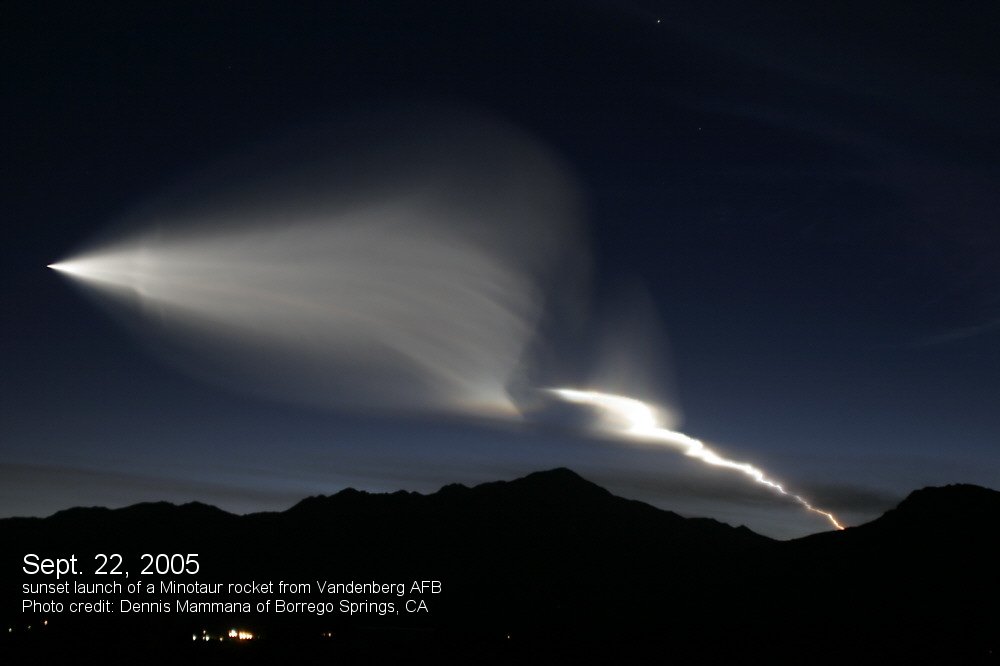
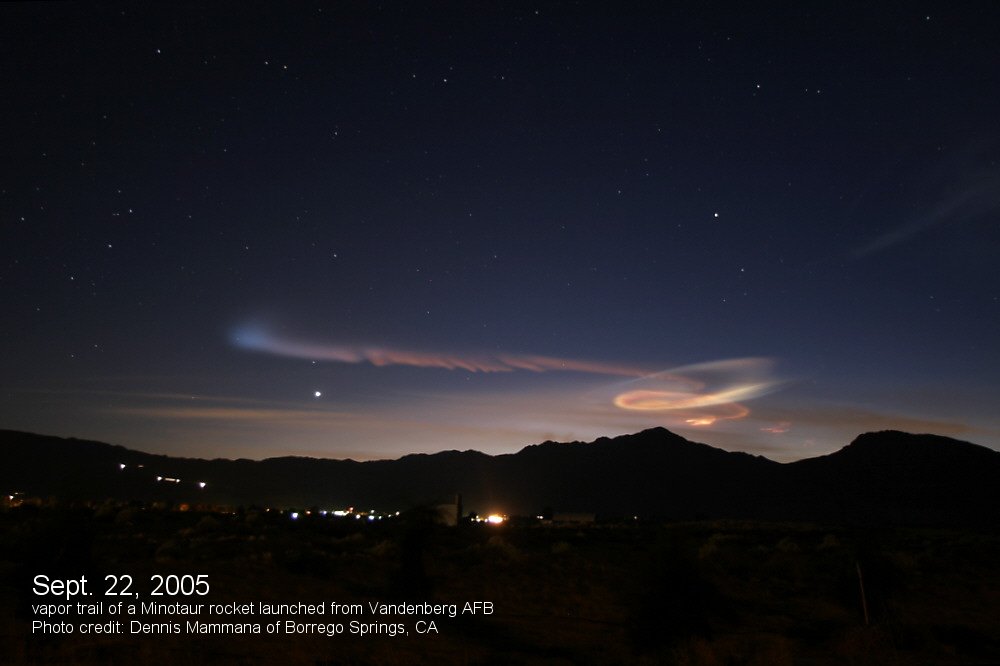
A Minotaur rocket blasted off from Vandenberg Air Force Base near Los Angeles on Sept. 22nd, creating a sunset vapor display that amazed onlookers all the way from southern California to Arizona.
Wednesday, September 21, 2005
Hoofbeats In The Distance?
The flu epidemic of 1918 took more lives in one year than the total dead of World War I.
It will happen again.
Airplanes... god damned airplanes. If you hadn't already read The Hot Zone years ago, you should.
Meanwhile, shiver me this.
Indonesian Capital May Be Facing a Bird Flu Epidemic (Update1)
Sept. 21 (Bloomberg) -- Indonesia's capital Jakarta and its surrounding areas may be facing a bird flu epidemic after at least four people died from the disease, Agriculture Minister Anton Apriantono said.
The government plans to spend 134 billion rupiah ($13 million) this year to cull poultry in the affected areas, Apriantono said in a phone interview in Jakarta.
"It may be right that it is an epidemic in Jakarta and Tangerang,'' which is 25 kilometers (16 miles) west of the capital, Apriantono said. "So that's why we are concentrating on our efforts in Jakarta and Tangerang.''
Indonesia confirmed its first bird-flu deaths on July 20, after a man and his two daughters died from the virus. The fourth human fatality, a 37-year-old woman, was confirmed to have been killed by bird flu on Sept. 10, Indonesian Health Minister Siti Fadilah Supari said on Sept. 16.
Avian influenza has infected more than 100 people in Asia and killed about half of them since 2004, three health agencies, including the World Health Organization, said last month.
More than 140 million chickens have been slaughtered in Asia because of concern that H5N1 virus may mutate into a form easily transmissible between humans.
As humans are unlikely to have immunity to a mutated strain of H5N1, the World Health Organization is concerned it may trigger an influenza pandemic like the one that led to more than 40 million deaths worldwide in 1918. All cases of human infection in Asia are believed by health officials to have come from animals.
'Huge Problem'
Indonesia also plans to draft a law that will allow it to punish farmers who refuse to kill their poultry, Apriantono told reporters yesterday after a meeting with President Susilo Bambang Yudhoyono to discuss ways to halt the spread of the avian influenza virus.
"The problem is so huge and the international community's capacity to reach each and every chicken farmer is very small,'' Benni Sormin, assistant country representative for the Food and Agriculture Organization in Indonesia, said in an interview.
The Indonesian government has set up a polymerase chain reaction lab to test blood samples for the H5N1 virus in eight provinces. The technique, which is known as PCR, is used to create copies of specific fragments of DNA. PCR amplifies a single DNA molecule into billions of molecules.
So funny I could die.
Friday, September 16, 2005
Sounds Better Than No Plan At All
Nasa says they're gonna get to the moon with spare parts...
Heck, that's good enough for me. Here's the scoop from mega-cool periodical USAToday:
NASA to unveil plans for 2018 moon mission
By Brian Berger, Space.com
WASHINGTON — NASA briefed senior White House officials Wednesday on its plan to spend $100 billion and the next 12 years building the spacecraft and rockets it needs to put humans back on the moon by 2018.
(Apollo 12 mission Commander Charles P. "Pete" Conrad is shown on the moon's surface in this Nov. 1969 file photo. NASA file via AP)
"America! FUCK YEAH! Coming again, to save the mother fucking day yeah"
The U.S. space agency now expects to roll out its lunar exploration plan to key Congressional committees on Friday and to the broader public through a news conference on Monday, Washington sources tell Space.com.
President George W. Bush called in January 2004 for the United States to return to the moon by 2020 as the first major step in a broader space exploration vision aimed at extending the human presence throughout the solar system.
NASA has been working intensely since April on an exploration plan that entails building an 18-foot (5.5-meter) blunt body crew capsule and launchers built from major space shuttle components, including the main engines, solid rocket boosters and massive external fuel tanks.
That plan, called the Exploration Systems Architecture Study, was presented by NASA Administrator Mike Griffin, his space operations chief Bill Gerstenmaier and several other senior agency officials Wednesday afternoon to senior White House policy officials, including an advisor to Vice President Dick Cheney and the president's Deputy National Security Advisor J.D. Crouch.
NASA's plan, according to briefing charts obtained by Space.com, envisions beginning a sustained lunar exploration campaign in 2018 by landing four astronauts on the moon for a seven-day stay.
The expedition would begin, these charts show, by launching the lunar lander and Earth departure stage (essentially a giant propulsion module) on a heavy-lift launch vehicle that would be lifted into orbit by five space shuttle main engines and a pair of five-segment shuttle solid rocket boosters.
Once the Earth departure stage and lunar lander are safely in orbit, NASA would launch the Crew Exploration Vehicle capsule atop a new launcher built from a four-segment shuttle solid rocket booster and an upper stage powered by a single space shuttle main engine.
The CEV would then dock with the lunar lander and Earth departure stage and begin its several day journey to the moon.
NASA's plan envisions being able to land four-person human crews anywhere on the moon's surface and to eventually use the system to transport crew members to and from a lunar outpost that it would consider building on the lunar south pole, according to the charts, because of the regions elevated quantities of hydrogen and possibly water ice.
One of NASA's reasons for going back to the moon is to demonstrate that astronauts can essentially "live off the land" by using lunar resources to produce potable water, fuel and other valuable commodities. Such capabilities are considered extremely important to human expeditions to Mars which, because of the distances involved, would be much longer missions entailing a minimum of 500 days spent on the planet's surface.
NASA's Crew Exploration Vehicle is expected to cost $5.5 billion to develop, according to government and industry sources, and the Crew Launch Vehicle another $4.5 billion. The heavy-lift launcher, which would be capable of lofting 125 metric tons of payload, is expected to cost more than $5 billion but less than $10 billion to develop, according to these sources.
NASA's plan also calls for using the Crew Exploration Vehicle, equipped with as many as six seats, to transport astronauts to and from the international space station. An unmanned version of the Crew Exploration Vehicle could be used to deliver a limited amount of cargo to the space station.
NASA would like to field the Crew Exploration Vehicle by 2011, or within a year of when it plans to fly the space shuttle for the last time. Development of the heavy lift launcher, lunar lander and Earth departure stage would begin in 2011. By that time, according to NASA's charts, the space agency would expect to be spending $7 billion a year on its exploration efforts, a figure projected to grow to more than $15 billion a year by 2018, that date NASA has targeted for its first human lunar landing since Apollo 17 in 1972.
Senate approves $16.4 billion budget
The U.S. Senate approved a $200 million budget increase for NASA Thursday.
The NASA funding was approved as part of a $48.9 billion spending bill that also funds the Justice and Commerce Departments. Of that amount, NASA would receive $16.4 billion for 2006, about $60 million less than the agency requested but $200 million more than it had to spend this year.
The House of Representatives approved NASA's budget in July, providing $15 million more for NASA than it requested but the House bill also would require NASA to spend $110 million more on aeronautics research than it would like, or $952 million.
Similarly, the Senate bill would require NASA to spend $250 million in the year ahead preparing for a space shuttle mission to refurbish the Hubble Space Telescope. NASA requested only a fraction of that amount for the proposed mission.
Sen. Barbara Mikulski (D-Md.), a senior member of the Senate Appropriations Committee, issued a press release Thursday afternoon highlighting, among other things, the extra money added funds for the Hubble Space Telescope. Her press release also states that the $16.4 billion approved by the Senate "fully funds all major space science and earth science programs, the space shuttle, space station, the Crew Exploration Vehicle (CEV) and the Moon-Mars initiative."
The Senate passed the spending bill by a vote of 91-4.
The House and Senate now must work out the differences between the two bills before sending the spending legislation to the White House for the president to sign into law.
Thursday, September 15, 2005
Monday, September 12, 2005
Friday, September 09, 2005
Wednesday, September 07, 2005
Cultural Schizophrenia
Artwork by: Tien Yang
Hey folks, here's one from a couple years ago...
(excuse my recycling, somehow it seemed to fit this period of time as our eyes empty New Orleans)
Cultural Schizophrenia
Dimes drip from the tip of his fingers
Far off wildfires drape orange clouds over the city
Life has become a waiting, a sweat between wrist and watch
Nervous eyes flicker in bouts of paranoid peering
The corners carry spiders, the stains on the carpet move of their own accord
Dancing motes of light whisper
Streak vision blurs conception, clarity, confusion
Pressures crack the glass, water pouring, pressing, breaking in
Tunnels of low consciousness swallow our sounds
Words come from the nightmare of waking ominous waking on the bus
Ours is a glass of hours
We file like tethered beads through the narrow eye
The dogs strain, choking on the leash
Time is coming
The world demands attention, portrayal, extension,
participation, expression, analysis, explanation, help
Spell check my soul
Spell check all our souls
Life in these times demands, asks, wonders where we are going
Remember what days, what nights, what life we have before
The pivot that divides us before and us after
Help choose the right path
Find magnetic hearts sitting skewered in pools, floating free, pointing
Endure the time of pain, grieve the process, take the steps to sanity and harmony and living
Time never asks. Ask never, this time
Backwards through the night through to dawn; back from noon to the morning
The moorings rip loose
The great ship cast adrift
The flags tattered, the squall oncoming
The wailing of millions
This time is the time of time begging definition
The change this time is asking us to see it
To know what we are
To be eyes in the storm
Our hands grasp, clutch, grope for meaning
The meaning is this meaningless
Tongue chewing inference, implication, intuition
Intelligence beguiled
Wednesday, August 17, 2005
El Hombre Nuevo Speaks
Hey folks,
I have the pleasure of introducing a new contributor to The Rubber Wall:

-El Hombre Nuevo-
Human Destiny and the Truth About Oil
Oil has allowed the greatest economic expansion in all of human history. Our blind dependence upon it might cause the greatest economic collapse in all of human history. Walking the fine balance of irony is part of what it means to be human. If the human brain were a claw, it would be 10 feet long, razor sharp and impossibly nimble. It’s a good thing we have this ‘claw’ because compared with other animals we are not well suited to survival. We are weak, slow, blind, soft and lack sharp implements in our jaws or on our limbs. In the past we learned to build spears, plant crops, and weave fabrics. We learned we could pump a certain black substance out of the Earth, set it on fire and greatly improve our standard of living by doing so. It’s been a great ride but we now need to use our cranial Swiss Army knife to arrange for the next energy disaster. We will be caught with our pants down. The first step to take to prevent this disaster is to gain a proper understanding of the ideas and concepts involved. I hear so many ignorant comments on the subject that it is clear a better understanding is needed.
Price Determines Supply. The Bronze Age did not end for lack of bronze, and the Oil Age will not end for lack of oil. We will never run out of oil. If you are willing to pay $50 per gallon for gas, it will always be available. I hear so many people ask “when will we run out of oil?” The real question should be “when will we run out of oil that can be obtained at a price people are willing to pay?” Our goal here is to determine the magic threshold point. Below this point (price), people are willing to pay. Above this point, people will say ‘screw it.’ Are people willing to pay $5 per gallon? Experience suggests that we are. The Europeans have been paying this price for some time now. However, relative to North America, cars in Europe are small and efficient, ownership rates are low, and distances traveled are short. Would North Americans be willing to pay $5 per gallon? Maybe. We could adopt smaller cars and use more public transportation, but nothing will change the fact that North America is huge and the distances traveled are vast.
The problem with trying to peg down this threshold price is that it is not fixed in stone. It is a moving target. My car gets 30 mpg. At this level, would I be willing to pay $5 per gallon? Basically, no. I would not sell my car, but I would not drive it more than once a week or so (I am lucky, I can walk to work). If my car got 60 miles per gallon, would I be willing to pay $5 per gallon? Sure. The point is clear. The efficiency of our vehicles determines the threshold point. We can greatly expand the supply of affordable oil by increasing the efficiency of our cars and trucks. However, this is not a long term solution. Why? There is an upper limit to the efficiency of the internal combustion engine. Setting something on fire to extract its energy is still cave-man technology, even if it does come in a shiny red package with a satellite navigation system. We can do better. Understanding that a threshold point does exist and that its location depends upon the efficiency of our vehicles is the first bit of information needed to prevent the above-mentioned pants and ankles situation. What lesson does this bit of information teach us?
Build more efficient cars and we will buy ourselves time.
New efficiency laws would speed this process, but the market solves most problems on its own. (Message to Detroit: the Japanese are kicking your butts in this department. Stop investing all your money in developing the newest, biggest, 400 horsepower machine. Market forces will destroy you. You are already losing the quality battle with the Japanese, you cannot afford to lose the efficiency battle too.)
Oil Production. The rate of oil production has been increasing since the first day of production. So has the rate of consumption. The fact that BOTH of these graph lines have been upwardly slopping means that the price of oil has been basically stable for a very long time. The problem we now face is that the production line will not always have an upward slope. There will come a day when production can no longer increase. This does not mean production will decrease right away, only that it can no longer increase. Oil Production will flatten out in the near future, but consumption will continue to increase. One need only attend the first 10 minutes of the first day of Economics 101 to understand what this means. Prices will skyrocket. It is at this point that the Oil Age effectively ends. With the combined populations of China and India (1/3 of humanity) now actively bidding against North America and Europe on the world oil market, the stakes and consequences of this production problem are enormous.
So, why will the production line flatten? Most of the cheaply gotten oil has already been pumped, is already being pumped as you read this, or is already mapped out. Drilling technology will continue to improve and this will delay our day reckoning somewhat. Again, however, this is not a long term solution. Why? There is an upper limit to drilling technology. Pulling things out of holes ripped into the Earth’s crust is still cave-man technology, even if it is aided by ground-penetration radar. We can do better. Understanding that oil production will level off is the second bit of knowledge we need to have. Understanding that this leveling off point is the end of oil for all practical purposes is the third bit of knowledge we need. What lessons do these two bits of information teach us?
If we do not have a replacement in place or near when the Oil Age ends, we will be in serious trouble.
Talk about being caught with our goods hanging in the breeze. The best ‘belt’ in the world will not keep our pants around our emaciated hips. We need to start investing in the replacement NOW…YESTERDAY.
Action. We need a worldwide ‘Manhattan Project.’ We shall build a huge complex somewhere, give the project an unlimited budget, give it the best scientific minds from all over the world and let them work. It doesn’t matter if it costs 500 billion dollars or double that. Whatever it costs, the alternative is worse. Whatever it costs, the investment will be paid back 1000 fold. Why? Oil is and always has been inefficient. However, human ingenuity has allowed us amazing economic expansion, even with this inefficient energy source. The alternative to oil will be vastly more efficient. Imagine the economy we could build with that. So what does this new energy source look like? What is it called? These questions remain to be answered, but for the sake of this discussion, let’s call it: The Free Energy Machine (FEM).
Now, I just lost a certain percentage of readers. These are the naysayers. Now that they are gone, I can say mean things about them. These are the people who said humans will never fly. These are the people who, after the invention of the airplane, said that humans will never fly faster than sound. These are the people who, after the sound barrier was broken, said that humans would never leave the Earth, or walk on the Moon. There are many basic laws of humanity. One of them is: There will always be people who lack the imagination to grasp the true potential of human imagination. Another is: There is no limit to human imagination, creativity, or technological potential. This does not mean that certain technological paths are unlimited (fire, drilling), only that technology, in general, is unlimited. To those who say the FEM is a Star Trek fantasy, I would say that the weight of human history is against you. Could a person from the 18th century imagine a modern laptop computer? Could the Wright brothers have imagined that less than 69 years after their first flimsy flight humans would fly to the Moon? There is an unbroken chain of human ideas and knowledge leading from a roughly chipped stone tool to the remote control robots we have on Mars. Is there any reason to believe this chain is at its end? Another basic law of humanity: With all problems, imaging a solution and believing that it can be done is 90% of the work, actually doing it is only 10%. We are blessed to live in interesting times. We are cursed to live in interesting times. The Oil Age is coming to an end. Humanity either invents the FEM or slips into a nightmare situation. With 90% of the work already done on the FEM it would seem silly to choose the alternative. I understand that getting the international community to agree on anything is difficult. Steadily rising oil prices will spur both the international community and private research dollars to take the problem seriously. It is all a question of timing.
FEM & Human Destiny. Another basic law of humanity: Humans are explorers. Failure to explore results in psychological and physical degeneracy. People are endlessly curious about ideas and places. People need to see what is around the next corner. This is not a human hobby. This a human requirement. For the first 99.999% of human history, the need for exploration was easily satisfied. The Earth was a giant, unexplored wilderness. Humanity has always had a frontier, a place to send our young, restless souls and satisfy our need to see new things. Sometimes this frontier was already occupied and conflict resulted, but this is not the time for that story. Now, in the 21st century, what physical frontier is there? Every square inch of Earth’s surface is satellite mapped and GPS navigated. The limited exploring left is available only to those lucky scientists who can reach the ocean depths or the polar expanses. The rest of humanity is stuck. This problem is not merely an academic curiosity. It is real and must be addressed. It is the paramount crisis of our species. Where do we send our restless souls? Down to the corner for drugs? Drugs have nearly lost their original spiritual applications. They are now an escape device. Where to go to satisfy our human need? We have few things we can do to let off our explorer-steam pressure. We can go backpacking and pretend to explore. We can watch a nature show on TV and pretend even harder to explore. We can explore ideas through science and creative pursuits. These options are only band-aids.
The most basic law of humanity: You cannot change human nature. It is not logical to believe that the human need to explore would simply evaporate once the Earth was filled with our kind. We need space to explore. We need new SPACE. The human path has always led to the stars. Space is the great enzyme of human imagination and has been for all time. Our exploration of the Earth was but practice for the real game. We have made the first tenuous steps. The FEM will mark the real beginning. The FEM will do more than solve our Earth-bound energy needs. It will end our status as Earth-bound. The FEM will exist. The only question is how it comes about. Do we get it the easy way or the hard way? Do we hit the ground running relative to the end of the Oil Age, or do we suffer through harsh and ugly times first?
What do you think? What will you do? What is your part in our destiny?
///
Heehhehe, check this song out too. It musically illustrates the point.
http://toccionline.kizash.com/films/1001/178/index.php
I have the pleasure of introducing a new contributor to The Rubber Wall:
-El Hombre Nuevo-
Human Destiny and the Truth About Oil
Oil has allowed the greatest economic expansion in all of human history. Our blind dependence upon it might cause the greatest economic collapse in all of human history. Walking the fine balance of irony is part of what it means to be human. If the human brain were a claw, it would be 10 feet long, razor sharp and impossibly nimble. It’s a good thing we have this ‘claw’ because compared with other animals we are not well suited to survival. We are weak, slow, blind, soft and lack sharp implements in our jaws or on our limbs. In the past we learned to build spears, plant crops, and weave fabrics. We learned we could pump a certain black substance out of the Earth, set it on fire and greatly improve our standard of living by doing so. It’s been a great ride but we now need to use our cranial Swiss Army knife to arrange for the next energy disaster. We will be caught with our pants down. The first step to take to prevent this disaster is to gain a proper understanding of the ideas and concepts involved. I hear so many ignorant comments on the subject that it is clear a better understanding is needed.
Price Determines Supply. The Bronze Age did not end for lack of bronze, and the Oil Age will not end for lack of oil. We will never run out of oil. If you are willing to pay $50 per gallon for gas, it will always be available. I hear so many people ask “when will we run out of oil?” The real question should be “when will we run out of oil that can be obtained at a price people are willing to pay?” Our goal here is to determine the magic threshold point. Below this point (price), people are willing to pay. Above this point, people will say ‘screw it.’ Are people willing to pay $5 per gallon? Experience suggests that we are. The Europeans have been paying this price for some time now. However, relative to North America, cars in Europe are small and efficient, ownership rates are low, and distances traveled are short. Would North Americans be willing to pay $5 per gallon? Maybe. We could adopt smaller cars and use more public transportation, but nothing will change the fact that North America is huge and the distances traveled are vast.
The problem with trying to peg down this threshold price is that it is not fixed in stone. It is a moving target. My car gets 30 mpg. At this level, would I be willing to pay $5 per gallon? Basically, no. I would not sell my car, but I would not drive it more than once a week or so (I am lucky, I can walk to work). If my car got 60 miles per gallon, would I be willing to pay $5 per gallon? Sure. The point is clear. The efficiency of our vehicles determines the threshold point. We can greatly expand the supply of affordable oil by increasing the efficiency of our cars and trucks. However, this is not a long term solution. Why? There is an upper limit to the efficiency of the internal combustion engine. Setting something on fire to extract its energy is still cave-man technology, even if it does come in a shiny red package with a satellite navigation system. We can do better. Understanding that a threshold point does exist and that its location depends upon the efficiency of our vehicles is the first bit of information needed to prevent the above-mentioned pants and ankles situation. What lesson does this bit of information teach us?
Build more efficient cars and we will buy ourselves time.
New efficiency laws would speed this process, but the market solves most problems on its own. (Message to Detroit: the Japanese are kicking your butts in this department. Stop investing all your money in developing the newest, biggest, 400 horsepower machine. Market forces will destroy you. You are already losing the quality battle with the Japanese, you cannot afford to lose the efficiency battle too.)
Oil Production. The rate of oil production has been increasing since the first day of production. So has the rate of consumption. The fact that BOTH of these graph lines have been upwardly slopping means that the price of oil has been basically stable for a very long time. The problem we now face is that the production line will not always have an upward slope. There will come a day when production can no longer increase. This does not mean production will decrease right away, only that it can no longer increase. Oil Production will flatten out in the near future, but consumption will continue to increase. One need only attend the first 10 minutes of the first day of Economics 101 to understand what this means. Prices will skyrocket. It is at this point that the Oil Age effectively ends. With the combined populations of China and India (1/3 of humanity) now actively bidding against North America and Europe on the world oil market, the stakes and consequences of this production problem are enormous.
So, why will the production line flatten? Most of the cheaply gotten oil has already been pumped, is already being pumped as you read this, or is already mapped out. Drilling technology will continue to improve and this will delay our day reckoning somewhat. Again, however, this is not a long term solution. Why? There is an upper limit to drilling technology. Pulling things out of holes ripped into the Earth’s crust is still cave-man technology, even if it is aided by ground-penetration radar. We can do better. Understanding that oil production will level off is the second bit of knowledge we need to have. Understanding that this leveling off point is the end of oil for all practical purposes is the third bit of knowledge we need. What lessons do these two bits of information teach us?
If we do not have a replacement in place or near when the Oil Age ends, we will be in serious trouble.
Talk about being caught with our goods hanging in the breeze. The best ‘belt’ in the world will not keep our pants around our emaciated hips. We need to start investing in the replacement NOW…YESTERDAY.
Action. We need a worldwide ‘Manhattan Project.’ We shall build a huge complex somewhere, give the project an unlimited budget, give it the best scientific minds from all over the world and let them work. It doesn’t matter if it costs 500 billion dollars or double that. Whatever it costs, the alternative is worse. Whatever it costs, the investment will be paid back 1000 fold. Why? Oil is and always has been inefficient. However, human ingenuity has allowed us amazing economic expansion, even with this inefficient energy source. The alternative to oil will be vastly more efficient. Imagine the economy we could build with that. So what does this new energy source look like? What is it called? These questions remain to be answered, but for the sake of this discussion, let’s call it: The Free Energy Machine (FEM).
Now, I just lost a certain percentage of readers. These are the naysayers. Now that they are gone, I can say mean things about them. These are the people who said humans will never fly. These are the people who, after the invention of the airplane, said that humans will never fly faster than sound. These are the people who, after the sound barrier was broken, said that humans would never leave the Earth, or walk on the Moon. There are many basic laws of humanity. One of them is: There will always be people who lack the imagination to grasp the true potential of human imagination. Another is: There is no limit to human imagination, creativity, or technological potential. This does not mean that certain technological paths are unlimited (fire, drilling), only that technology, in general, is unlimited. To those who say the FEM is a Star Trek fantasy, I would say that the weight of human history is against you. Could a person from the 18th century imagine a modern laptop computer? Could the Wright brothers have imagined that less than 69 years after their first flimsy flight humans would fly to the Moon? There is an unbroken chain of human ideas and knowledge leading from a roughly chipped stone tool to the remote control robots we have on Mars. Is there any reason to believe this chain is at its end? Another basic law of humanity: With all problems, imaging a solution and believing that it can be done is 90% of the work, actually doing it is only 10%. We are blessed to live in interesting times. We are cursed to live in interesting times. The Oil Age is coming to an end. Humanity either invents the FEM or slips into a nightmare situation. With 90% of the work already done on the FEM it would seem silly to choose the alternative. I understand that getting the international community to agree on anything is difficult. Steadily rising oil prices will spur both the international community and private research dollars to take the problem seriously. It is all a question of timing.
FEM & Human Destiny. Another basic law of humanity: Humans are explorers. Failure to explore results in psychological and physical degeneracy. People are endlessly curious about ideas and places. People need to see what is around the next corner. This is not a human hobby. This a human requirement. For the first 99.999% of human history, the need for exploration was easily satisfied. The Earth was a giant, unexplored wilderness. Humanity has always had a frontier, a place to send our young, restless souls and satisfy our need to see new things. Sometimes this frontier was already occupied and conflict resulted, but this is not the time for that story. Now, in the 21st century, what physical frontier is there? Every square inch of Earth’s surface is satellite mapped and GPS navigated. The limited exploring left is available only to those lucky scientists who can reach the ocean depths or the polar expanses. The rest of humanity is stuck. This problem is not merely an academic curiosity. It is real and must be addressed. It is the paramount crisis of our species. Where do we send our restless souls? Down to the corner for drugs? Drugs have nearly lost their original spiritual applications. They are now an escape device. Where to go to satisfy our human need? We have few things we can do to let off our explorer-steam pressure. We can go backpacking and pretend to explore. We can watch a nature show on TV and pretend even harder to explore. We can explore ideas through science and creative pursuits. These options are only band-aids.
The most basic law of humanity: You cannot change human nature. It is not logical to believe that the human need to explore would simply evaporate once the Earth was filled with our kind. We need space to explore. We need new SPACE. The human path has always led to the stars. Space is the great enzyme of human imagination and has been for all time. Our exploration of the Earth was but practice for the real game. We have made the first tenuous steps. The FEM will mark the real beginning. The FEM will do more than solve our Earth-bound energy needs. It will end our status as Earth-bound. The FEM will exist. The only question is how it comes about. Do we get it the easy way or the hard way? Do we hit the ground running relative to the end of the Oil Age, or do we suffer through harsh and ugly times first?
What do you think? What will you do? What is your part in our destiny?
///
Heehhehe, check this song out too. It musically illustrates the point.
http://toccionline.kizash.com/films/1001/178/index.php
Wednesday, August 10, 2005
Any One Got A Spare $100K?
Yes, yes, we know. I'm a space freak. I admit it. For reasons in my heart, in my head, and from deep instinct... I believe in space and see the human species there.
ok.
Now to this most recent story on the emerging space-tourism industry.
"""
August 10, 2005
Private Company Plans $100 Million Tour Around the Moon
One day after NASA brought the shuttle Discovery back from low Earth orbit, a private company plans to announce a more audacious venture, a tourist trip around the Moon.
Space Adventures, a company based in Arlington, Va., has already sent two tourists into orbit. Today, it is to unveil an agreement with Russian space officials to send two passengers on a voyage lasting 10 to 21 days, depending partly on its itinerary and whether it includes the International Space Station.
A roundtrip ticket will cost $100 million.
The space-faring tourists will travel with a Russian pilot. They will steer clear of the greater technical challenge of landing on the Moon, instead circling it and returning to Earth.
Eric Anderson, the chief executive of Space Adventures, said he believed the trip could be accomplished as early as 2008. Mr. Anderson said he had already received expressions of interest from a few potential clients.
The Soyuz vehicle to be used does not have the power to reach the Moon on its own, so the Russians have devised a plan to send up a booster. The Soyuz would dock with the booster, either in low Earth orbit or at the International Space Station.
The booster would take the passengers the rest of the way. The price of the two tickets, Mr. Anderson said, would pay for the costs of the Moon shot. His company's demographic research, he said, suggests that 500 to 1,000 people in the world can afford to do this.
"It's the same number of people who could afford to buy a $100 million yacht," Mr. Anderson added. Two people who have already paid Space Adventures to go into orbit, at a reported $20 million apiece, applauded the new initiative though they said they were not sure they would try the Moon orbit.
Dennis Tito, a financier who in 2001 became the first space tourist, said that he found the idea fascinating but added that he doubted he would make such a trip. Having just turned 65, and with the Moon orbit at least a few years away, he said he might be too old for the rigors of the voyage.
"I would be considering it if I were younger, and I had that kind of money to spare," Mr. Tito said.
Another Space Adventures client, Greg Olsen, who made millions in the sale of his camera technology company, Sensors Unlimited, is preparing to visit the space station for several days in October. Of the Moon trip, he said, "It's certainly intriguing, and it's something I'd like to do."
Will he buy a ticket, then? "One trip at a time," he replied.
The trip seems feasible, said Dr. John M. Logsdon, director of the Space Policy Institute at George Washington University. "As a nontechnical person, I don't see any technical showstoppers," Dr. Logsdon said, "if people are crazy enough to do it."
And, he added, it would make "a lot of money for the Russians."
Christopher C. Kraft, a former director of the Johnson Space Center, said his feelings about the enterprise were mixed. "I think it would be a fantastic journey," he said. "I could see why, if I had the price of the ticket and could use the money that way, that it would be tempting to go."
But Mr. Kraft added that the flight would be cramped and probably extremely unpleasant. With three people in a small Soyuz craft for an extended trip, he said, "I imagine that you could endure that, but, man, it would be tough."
Mr. Anderson of Space Adventures said the craft had about as much room as a sport utility vehicle. "Will it be cramped? Yes," he said. "But will it be doable? Yes."
He noted that the Gemini capsule was smaller than the Soyuz, and that the astronauts James A. Lovell and Frank Borman orbited the Earth for 14 days in the Gemini 7 mission in 1965.
But Mr. Kraft, who was the flight director for that mission, recalled that Mr. Lovell and Mr. Borman were miserable. They complained bitterly that the trip was like "14 days in a men's room," and Mr. Kraft said that he had to talk them out of ending the mission early. "They wanted to get out of there," he said.
Mr. Anderson said the timing of the announcement was not meant to tweak the National Aeronautics and Space Administration. "We believe private space flight and space exploration can go hand in hand, and can coexist and benefit each other," he said. Government, he said, should focus "on things that private companies cannot do," like exploring other planets. His company's system, he said, could eventually be a subcontractor, offering transportation services to a government Moon base.
"I just love the idea of demonstrating that things can be done for less money than people thought, and paradigms can be shifted," he said. "Space flight can be opened up."
"""
Link to original story by some unknown newspaper
Wurd.
Tuesday, August 02, 2005
Hear The Cliff
If you have two hours, and want to hear something fascinating and kind of scary...
check this:
Mp3 download
Link
or
Windows media (asx file)...this one seemed to have better sound quality though win-annoying
Link
Fast forward the time index to 34:30 or so, where the interview begins.
Play it on your speakers, put it on the mp3 player for the plane flight, whatever.
The interview ranges from computer programing to economics to philosophy, and of course, the predictive qualities of the webbot reports.
Cliff is the genius behind:
Monday, August 01, 2005
Mix And Match
Hey folks,
Here's an interesting read I found posted at http://urbansurvival.com/week.htm...
enjoy!
and never forget to "watch the skies!"
"""Hi George:
I've been thinking lately about the pull that religion had over people's lives in the past (and continues to do so in many places in the world). How could humans (with no genetic changes) abandon their ancient attraction to religious belief suddenly during the few centuries? Are we really smarter than earlier cultures? Or have we applied our bent to religion to a set of new targets?
My current idea is that widespread belief in often absurd "conspiracy theories" has sopped up people's religious impulses. I'm not talking about rational inquiry into alternative causes, but uncritical belief. Nobody is actually an athiest. We have a new religion - but it is based on the behavior of powerful humans rather than unseen gods. These mysterious "evil" humans have corrupted an initially perfect world of the past for their own ends. Everything bad is caused by them.
I've been driven by this thinking recently by several experiences. First, I teach students at a local college. I teach a lot of entry-level computer classes, as well as a "general studies" Biology class. The reactions of the supposedly sophisticated, non-religious students demonstrate a clear "retargeting" of their religious impulses.
Second, a conversation I overheard in my apartment building a few days ago crystallized my impulse.
Here's the conversation from my apartment: I think it's fair to say that many people in the US today do not see the lightning bolts that struck hapless scoutmasters this week as the result of a specific, conscious decision of an angry god. We all know they are physical phenomena, which operate without intelligence. This is one of the differences between religion and non-religion - intent. If lightning bolts strike due to various tumblings of matter and energy, it isn't religion, despite what the "science as religion" crowd says. The scouts are electrocuted for no reason, which means no human values need be applied to the event.
But, if the lightning bolts happened "for a reason" then religion is involved - there is a moral intent bound with the event.
Imagine my surprise yesterday hearing my neighbor talking with friends about the second scouting electrocution. This neighbor works in the entertainment industry, is frantically anti-Bush, and hates "the religious right."
Speaking to her friends, this neighbor pointed out that said lightning bolts slammed down just prior to a "Bush visit." She noted that "they" - the radical religious right - must be very upset that a lightning bolt hit prior to a Bush visit - I suppose they would interpret it as a bad omen.
But then my neighbor (who normally seems reasonable) broadly hinted to her friends that there was "something behind" this electrical event. A secret, which she did not clarify, was the REAL reason for the lightning bolt. What was it? She didn't quite say - we were left to imagine the CIA manipulating the weather, a secret weapon tested on the American public, a warning to Bush from his "masters" - you name it.
Here's the fascinating part. In the same speech, she made it abundantly clear that she was an "athiest" and hated "religious" people. But here she was imagining hidden causes, meaning, and purpose behind the event. She was doing EXACTLY what she thought "the religious right" would do - ascribe meaning to a random physical event!
Frankly, it doesn't really matter whether the lightning bolt actually from a flying saucer - despite herself, this woman believes in higher powers, and in miracles. I listened for an hour as she darkly hinted at the sinister implications of the lightning strike - never exactly saying that it was "meant" to happen - but implying this very thing over and over.
Who is "god" in her religion? People. Instead of a big thunder-being up in the sky making the rain come, sneaky people are in a vast conspiracy. Like the unseen the god, "they" cannot be touched, uncovered, or even seen by lowly mortals. Yet the believer knows that they are there - no mater what the physical evidence is. In their faith, the believer triumphs over those who have not been enlightened.
I believe (with my degree in Biology) that the religious impulse is partly innate. Rather than moving beyond religion, as Marx, Skinner, and others hoped we would do, we have simply directed our prayers to a different object. Instead of classical gods, our new gods are people - people with vast, mysterious godlike power.
There are several reasons for the change in our civilization from a "god" - worshiping culture that one that worships mysterious humans in conspiracies. These changes challenged the old gods, but replaced them with equally supernatural new ones. These have led to a set of non-rational beliefs about the world which characterize our "conspiracy" religion.
In short, here is a summary:
1. Everything is controlled by a higher power - there are no random events. But this power is human, and human only. 2. Secret groups of people with this power cause everything to happen. 3. They have this vast power because absolutely anything is possible. As long as I imagine it, it can and will happen. There are no limits except human ones. 4. Since there are limits in my life, they can only have been created by humans. 5. If not for the conspiracy, we would be in a Paradise. All bad things in the world were caused by humanity - there is nothing outside humanity. Before humanity had godlike powers, everything was perfect.
Below, I've laid out the logical steps that have led to this belief system:
Belief #1 - "Thou shalt accelerate your technology forever faster"
At one time, technological innovation was seen as just that - a better way of doing things. This was characteristic of the 19th and early 20th centuries, in which much of the real "heavy lifting" of technological took place. People celebrated the ability of the human mind to discover things.
But now, technological advance is an unstoppable force int its own right, independent of humanity itself. It isn't that we manage to discover new technology - instead, an unstoppable spiritual force force us to advance technology ever-faster.
One of the clearest examples of this religious belief is the so-called "Moore's Law" which says that computer speeds double every 12-18 months. When Moore originally published his paper in the 1960s on compute speed increase, he presented it as an empirical study of the semiconductor industry. At this point, no religion was evident.
But now we have moved to a new idea - Moore's Law is a rock-solid given and computer makers "must" continue to to speed up computer because Moore's Law requires them to do so. It is moved from a statement of being to a moral law!
Consider the difference in the following statements:
a. Computer speeds are doubling every 18 months due to shrinking transistors (~1965).
b. Computer speeds ALWAYS double every 18 months. Any company that doesn't double the speeds of its computers is "not upholding" Moore's Law. But will someone double those speeds - Moore's Law cannot be stopped (~2000). But never, fear, Moore's Law is being upheld in the latest gadget.
In fact, computers are not following Moore's Law anymore. PC speeds topped out at about 3 GHz clockspeeds a few years ago, and Intel announced in late 2004 that they were NOT going to produce a 4GHz cpu for the indefinite future. True to the religious aspects of Moore's Law, writers in the tech industry ignored this challenge to their faith. They take the rise of 64-bit computing as "proof" that Moore's Law is still active - despite the fact that 64-bit computers are not faster - though they can more RAM.
"Multicore" processing is also taken as proof for Moore's Law "making" something happen just as we can't increase clockspeeds. In other words, Moore's Law "acted" and a new way to increase computer speed automatically appeared. This is despite that fact that for most non-server applications multicore systems give minimal speed boosts. It's similar to the faith that every time humanity use up one energy source (wood, coal) another, better energy source "automatically" appeared.
Even though the tech writers know there are limitations at some level, they remain confident that "somehow" Moore's Law will be upheld and computers will get faster forever.
Their faith that mysterious forces also ignore the fact that the utility of computers (their real value) have not increased with speed. The 2004 Macintosh G5 computer is about 1000 times faster than the 1984 Macintosh in hardware terms. But go back and look at the 1984 Mac. Running at 1/1000 the speed, it sported a useful word processor using full window/mouse/graphical systems. It also had a drawing program that looks very much like Adobe Photoshop today.
True, the word processor didn't have a spell check, and the paint program was in black and white. But are today's word processors and paint programs really 1000 times better than 1984? I would guess they are 10-20 times better. Even if computer speeds are rising, their utility to society is rising at a much slower rate!
Yet, Moore's Law is now a true LAW that all tech companies must uphold or face destruction. Any time there's an announcement of a change in memory, processors, etc, the tech industry assures that the new innovation ensures that they are keeping the faith - that Moore's Law will be kept, no matter what. Today, even though computers are leveling out in speed and utility, a stubborn faith in endless speed increases persists.
This belief system reaches its extreme stage in those beliving in the "singularity" - a sort of technological Rapture. These people believe that Moore's Law is accelerating, and that computer power will literally become infinite about the year 2040. The basis for their belief? "Moore's Law". But it is not a law, it is an observation, at best a hypothesis - not a unstoppable force.
Moore's Law forms one of the new pillars of faith among the general public as well. Outside the techies (hoping to be transported to the divine by the multi-pentahertz machines of 2038), the average person firmly believes that "technology always gets better". Tell someone that technology can halt, even reverse its advance, and you are met with disbelief. You've challenged a tenet of their new religion - the god Technology will always get better despite us.
In my mind, this is why it is so hard for many people to believe that we might have some real problems coming in permanently higher energy prices, loss of oil, degradation of the environment, etc. Try telling someone that computers won't be that much faster in 10 years, and they shake their head. They "know" they will be, even if they know absolutely nothing about how computers work.
A similar faith surrounds economics. People simply won't believe that prosperity always increases - things can only go up. There can be no economic waves or cycles. If they happen, "they" made them happen.
If we aren't richer this year, it must be a conspiracy.
Belief #2 - Anything is possible if you "wish upon a star" I've adapted this idea from James Kunstler's excellent writing. The belief in Moore's Law, along with increasingly detailed fantasies in movies and games has made people believe that "anything" is possible. The fact that technology has improved means it will improve infinitely.
This goes beyond believing that more will be possible in the future - it is the belief that absolutely anything is possible, or will be shortly.
This belief is qualitative, and ties in with the decline in quantative thinking. If someone imagines something in their head, it must therefore be possible. There can be no limits, even quantative, physical ones. It's like the miracle of the loaves and fishes - if I can imagine bread, then it follows that everyone can be fed from one loaf.
Case in point: I've tried repeatedly to explain to my students that a purely solar-powered car can't be like cars today due to the laws of thermodynamics. In full sunlight a few thousand watts fall on a car, and if this was 100% converted to energy the car would have a few horsepower at best.
But even after this discussion, students still insist that "someone will figure something out." The laws of nature aren't relevant - "they" will of course solve it and make a solar car that goes 300 miles an hour. (In fact, they already have and are suppressing it). The students don't reason out of any understanding of physics or technology. When pressed, students essentially say that since we can imagine solar cars and they are neat, they "must" be possible.
There's a similar touching belief in "air cars" beloved of science fiction - despite there being nothing remotely practical in this area. When I ask students why we don't have air cars, they typically say that that the "auto companies" don't want us to have them. No mention of the fact that there is no anti-gravity needed to make a silent, easily driven, Jetson's style machine. If I point this out, they are sure that "they" will discover a way to float air cars.
It's not that we might discover something in the future - it's that it is impossible for us NOT to do so!
This uncritical belief that anything is possible is why nobody seriously believes that energy will become scarce. Anything is possible, so it will happen. Energy might exist, so it will. If I note that oil reserves are dropping, students say that there could be undiscovered oil. That's enough for them - if we can imagine "oil not discovered", it must be there! Again, no knowledge of geology and physics goes into this argment - only a belief that anything is possible.
Belief #4 - There is nothing outside human experience. Humanity is everything, and anything I hear about MUST have been caused by humans.
If you believe that anything is possible, then the reason it hasn't happened yet is not any limits placed by Nature. Instead, any barriers, limits, boundaries to infinite personal freedom and power MUST be due to people. By extension, this means that people are responsible for everything that exists in the world.
True, in the past people might have believed in "anything goes" reality. For example, many believed that immortal beings that could fly. But they would have thought they were a "supernatural" being outside of humanity.
Today, people feel that immortality "must" be possible simply because I can think it. Therefore, it HAS happened, or is about to happen. The only reason it hasn't is due to humanity. Humanity is the only source of boundaries in the world.
This idea has been greatly spurred along by advances in entertainment technology. Movies today have computer-generated characters, objects, and machines that defy physical reality. Advances in animation have allowed us to give these impossible creatures and devices disturbing aspects of realism. The trend is even stronger in videogames, which virtually everyone under age 35 plays today. Today, the typical teenager has replaced outdoors unstructured play with play in virtual worlds, obviously constructed by people. If you belive the videogame is "realistic" then stuff in the videogame could easily happen in our world.
We see the ultimate fusion of virtual worlds, conspiracy, and a belief that anything is possible in "The Matrix" movies.
As a result, adherents of the new religion reject the notion that any barrier to their wants (read consumerism) is due to outside forces. They can only be human-caused.
Belief #5 - Since anything is possible, the only barriers are human will. So, if something has not happened that should, it is due to an evil "conspiracy" of humans.
I recently saw this belief when I asked my students to weight the pros and cons of AIDs virus being created by the US military. I provided evidence from both sides - in particular recent discoveries of AIDs cases reported in the 1930s and 1940s from European sailors visiting West Africa. I asked the students to use the evidence to justify their position, pro or con.
The result? Most completely ignored evidence both for and against. Instead, they assumed a conspiracy, and assumed that all the evidence I provided has been doctored. When they read about old AIDs cases from the 1930s and 1940s, they immediately postulated that the old cases were "planted" to support the conspiracy. When I noted that our ability to engineer viruses was primitive in the 1960s (when AIDs is supposed to have been created), the students immediately postulated that a "secret lab" stumbled on the techniques of advanced genetic manipulation. When I pointed out that plagues have attacked people for thousands of years, one student even suggested that this was "disinformation" - in other words, we were disease-free until the late 20th century.
Only a very few students suggested rational ideas - e.g., that we should look closely at the RNA structure of AIDs for signs of manipulation, check published papers from the 1960s and 1970s, etc. and use this evidence to make a decision on the question. These students were the only ones who are not part of the new religion.
The rest, like all zealots, ignored all the facts to support their belief: anything is possible, so AIDs MUST have been created. Since it is bad, it was created by evil people, since people are responsible for everything. This was not a hypothesis that could be falsified - it was religious certainty impervious to contrary information.
Belief #5 - Everything was perfect until "they" took over In our culture today we have largely isolated ourselves from anything outside the human sphere. We no longer have the direct, daily contact with the natural world that our ancestors did. We have moved from being isolated from the harsh aspects of nature to believing that nothing happens outside the human sphere.
I see this frequently when I ask students about the physical world - they're just as likely to believe that earthquakes are caused by someone with earthquake machines as that physical properties of the Earth cause them. In fact, the latter seems less likely to them - after all, they can imagine an earthquake machine, and they saw a movie with one once.
Because people do admit that humanity had less power in the past, they accept that earthquake machines could not have existed long ago. But, instead of concluding that earthquakes may be natural, they apparently believe that there were no earthquakes back then. In fact, there is a widespread belief that nothing bad happened in the old days - simply because humans couldn't make bad things happen yet.
As an example, I've described to students how we eradicated polio from the US in the 1950s and 1960s. Many students are surprised to discover that diseases existed back then! When asked, they apparently believe that the world used to be disease-free, and all our diseases today are caused by a "drug company" conspiracy.....
So, there you have it - our new religion. This faith even includes local gods and goddesses who cannot be blasphemed - usually entertainment celebrities. People who have no problem mocking conventional religions bristle with anger if you attack a "fallen" celebrity like Kurt Cobain - a depressed musician who killed himself with self-destructive behavior. He cannot be bad-mouthed - it's not allowed... It's amazing what sacred cows entertainment celebrities have become - while some may be mocked, others (e.g. rapper Tupac) cannot be blasphemed under any circumstances. I suspect this results from the lack of physical religious artifacts in the conspiracy religion - one must have something tangible and "good" to worship. The unreal world of entertainment celebrities substitutes for the gods of the past.
==========================
You might be amused by my final demonstration of the new religion, and the credulity of its followers. Last week, I told a class of students that the Atlantic is only 20 feet deep, London is 10 miles away from New York, and ocean liners run on metal tracks between the two cities. The reason? There's a conspiracy by the oil companies to keep plane tickets high - they just fly the planes around for several hours to burn up fuel on so-called "transatlantic" flights. The ocean is 20 feet deep because metal can't float - and the ships are made of metal. Ergo, the ships would sink except that they are on tracks on the ocean bottom.
Within 20 minutes I had several students actually supplying "supporting evidence" for my concept- in particular, the idea that "they" want us to burn oil seemed like "proof" to them, as did their inability to reason out why metal ships do float.
After about 30 minutes I stopped - I was worried that I had spawned a new cult! "
Pete Markiewicz (Web site)
"""
There ya go...something to chew on.
Stay conscious of the capital "T"s you put on your "They"s throughout the day.
Subscribe to:
Posts (Atom)